

.
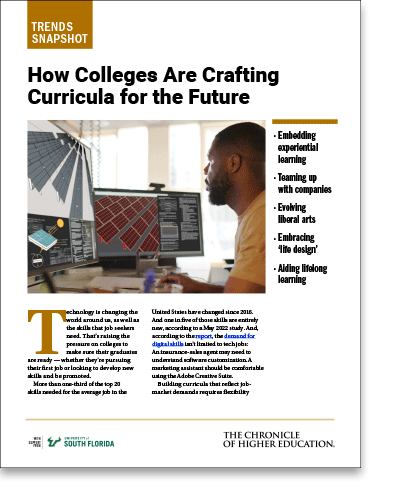
More than one-third of the skills needed for the average job in the United States has changed in 2016 and one in five of those skills are new.
The reason behind the rapid pace of change is, of course, evolving technology. Even applicants for non-technical roles are expected to have familiarity with software tools that they’ll use every day.
Universities need to ensure that their graduates leave fully equipped to thrive in the workforce. Explore The Chronicle’s latest Trends Snapshot to learn five ways universities are leading the charge in adapting their curricula for the future:
The reason behind the rapid pace of change is, of course, evolving technology. Even applicants for non-technical roles are expected to have familiarity with software tools that they’ll use every day.
Universities need to ensure that their graduates leave fully equipped to thrive in the workforce. Explore The Chronicle’s latest Trends Snapshot to learn five ways universities are leading the charge in adapting their curricula for the future:
- Embedding experiential learning
- Teaming up with companies
- Evolving liberal arts
- Embracing ‘life design’
- Aiding lifelong learning
By submitting this form, I agree to share my information with The Chronicle and University of South Florida for marketing purposes.
.
More than one-third of the skills needed for the average job in the United States has changed in 2016 and one in five of those skills are new.
The reason behind the rapid pace of change is, of course, evolving technology. Even applicants for non-technical roles are expected to have familiarity with software tools that they’ll use every day.
Universities need to ensure that their graduates leave fully equipped to thrive in the work force. Explore The Chronicle’s latest Trends Snapshot to learn five ways universities are leading the charge in adapting their curricula for the future:
The reason behind the rapid pace of change is, of course, evolving technology. Even applicants for non-technical roles are expected to have familiarity with software tools that they’ll use every day.
Universities need to ensure that their graduates leave fully equipped to thrive in the work force. Explore The Chronicle’s latest Trends Snapshot to learn five ways universities are leading the charge in adapting their curricula for the future:
- Embedding experiential learning
- Teaming up with companies
- Evolving liberal arts
- Embracing ‘life design’
- Aiding lifelong learning
.
.

